
A Major Setback in the Next Mission to the Moon and an Inflection Point for Commercial Space Companies
To 2027…and Beyond!


It was May 30, 2020, and it was a big day. In the early days of the COVID-19 pandemic and as the world tried to understand what it was dealing with, my wife and I stood still in the living room of some friends. We had gotten together that day to watch a piece of history and as the clock ticked down, the four of us stood watching.
Earlier in the day, we set up chairs outside, properly socially distanced. We laughed and caught up and enjoyed a potluck feast that we approached one at a time. It was a clear day in Northern Virginia just as it was at Cape Canaveral. Perfect launch weather. Our picnic was timed to coincide with this weather because it would enable a piece of history.
At the time, I was an emerging technology policy maker at the Department of Homeland Security (DHS) and space was within my remit. Leading up to the first launch of American astronauts from American soil since 2011, I did a lot of prep work for the Acting Secretary who attended the launch in person. Following this event, I had plans. Plans to create a new DHS space policy that would help carve a role for the Department in the opening of the commercial space economy. A policy that would make DHS more than an observer of space activities. The SpaceX launch of the Crew Dragon craft to the International Space Station that day was a moment for space travel and reason for many, government and private sector, to be excited about the future. A new era of space travel was upon us.
As if this wasn’t enough, there was more excitement to come around 2.5 years later. In November of 2022, the Artemis I mission launched for a 25-day mission. According to the NASA website:
Artemis I was the first in a series of increasingly complex missions that will enable human exploration at the Moon and future missions to Mars.
It also included this photo:
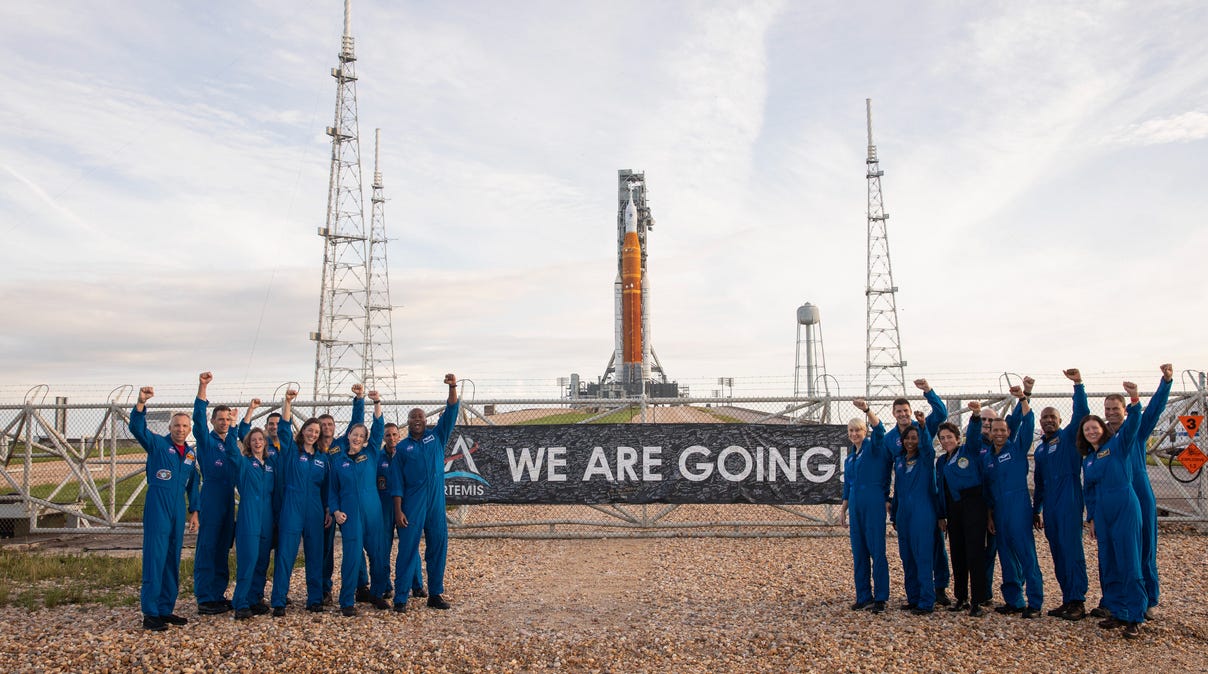
With American astronauts on one side and Canadian on the other, the rocket in the center says what we didn’t need the banner to hear. We are going. Where? To the Moon and to Mars.
In October of 2025, the Acting NASA Administration Sean Duffy made an announcement that verbally ripped down that banner. Due to setbacks at SpaceX in delivering its lunar lander, Duffy implied that the target of landing a crewed lander on the Moon by 2027 was no longer achievable. A lot took place between the November 2022 Artemis I launch and Duffy’s announcement including the stranding of two NASA astronauts in space for 286 days due to a malfunctioning Boeing spacecraft. Given the promise of the first Crew Dragon launch and the subsequent first Artemis launch, how has the air gone out of this effort so fast? What’s happened?
Whether the goal of landing Americans on the Moon again is achieved in 2027 or not does not change the setbacks that the commercial space industry is seeing. We’ve proven ourselves really good at putting things into low Earth orbit (LEO) but moving beyond has proven a challenge. Even trips to the International Space Station (ISS) are fraught as we’ve shown that 8 days might turn into 286 days. What’s going on? Are we hitting a ceiling with commercial space travel? Are we farther behind our big ambitions than we think? Possibly.
Launch Cost
If the commercial space industry deserves credit for one thing, it is the reduction in launch cost per kilogram. In space launch, you need to escape the Earth’s gravity achieving a speed called escape velocity. Escape velocity is the speed an object must obtain to overcome the gravitational pull of the Earth and enter space, 25,000 miles per hour for the Earth (as a combination of Earth’s rotational speed and the craft’s speed). Achieving that speed depends heavily on how much mass the escaping body has, so the lighter you are, the less energy you need. That means carrying stuff into space is expensive. Historically, the launch cost per kilogram has been as high nearly $51,000. The invention and perfection of the reusable rocket body dropped that cost down to under $1,600 as of the Falcon Heavy. This innovation alone opened the door to the launch of many more satellites creating not so much a “space industry” as a “LEO industry.”
Nevertheless, hope was high when the Crew Dragon got to the ISS. More successful missions followed but as anyone in the space industry knows, one bad one can turn public opinion and end your future endeavors.
All is Not Well
The most public example of the cracks that were forming in the commercial space industry happened in 2024 when Suni Williams and Butch Wilmore learned that their 8-day mission was now indefinite. The malfunctioning of their Boeing spacecraft left them with an uncertain return date that stretched into 286 days and made international news.
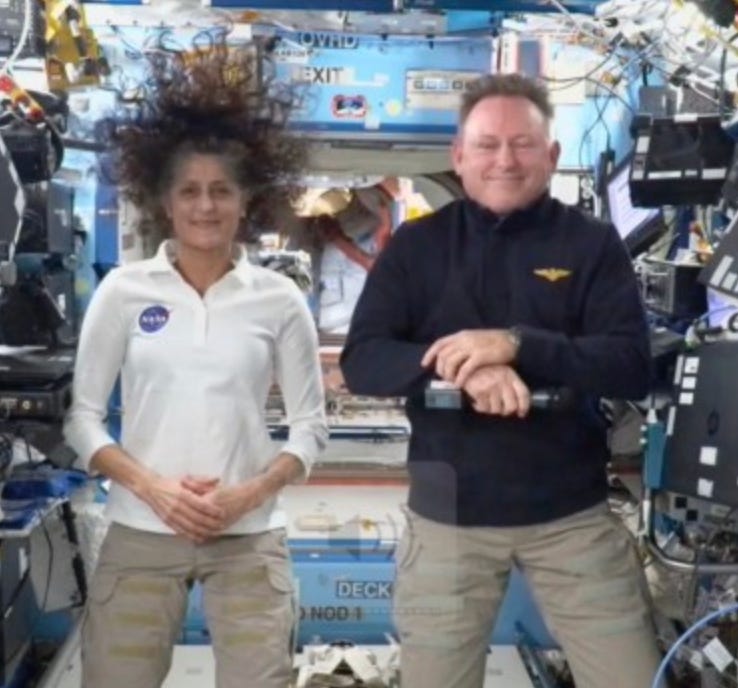
The incident shined a bright light on issues with Boeing’s crewed spacecraft that other companies such as Blue Origin and SpaceX sought to capitalize on. However, building a crew spacecraft to support ISS missions, let alone missions to the Moon has proven incredibly difficult.
The original launch date for the Artemis II mission was September 2025, but Cape Canaveral was quiet that day. Citing issues with the Orion crew vehicle (manufactured by Lockheed Martin), Artemis II was pushed back to a “no earlier than” date of April 2026, though NASA is targeting February 2026.
Now, as of October 2025, Acting Administrator Duffy is saying that SpaceX is having problems converting its crewed craft to a lunar lander and that the future mission to the Moon may drag into 2028. It seems that the space industry is struggling to build craft designed to go beyond LEO carrying humans. The reasons are not clear, but these setbacks should have investors and observers asking what’s wrong. The technology to get to the Moon has been understood, and has been built, since the 1960s, but in 2025, there seem to be new engineering challenges. The complexity of these systems must be part of the problem, but there also must be something else to it. Cislunar travel is something we once did with far less technology. Today, our knowledge seems to be suffering from atrophy. Or there’s something else to it.
A Limit for Space Economic Opportunity?
LEO is a proven region where economic opportunity exists causing several commercial entrants to seek revenue from satellites providing services to Earthlings with wallets below. While the projections of value beyond LEO have a lot of zeros at the end of them, we haven’t realized any of that value to date. NASA is seeking to fulfill its mission by pushing our exploration and scientific discovery farther from Earth, but they are using commercial companies to do it. Sure, previous missions have included large prime government contractors like Lockheed Martin and Boeing, but now new companies are competing for their business. Early signs looked good. Launch cost per kilogram came down and more satellites went up into space. Space travel was about to be much more accessible. Though manned flight has proven more difficult as traditional and new entrant companies have failed to meet deadlines and failed to bring humans back to Earth on time.
In the heyday of the space race, government contracts flowed and there were a small handful of companies that could fill them. Those companies could pull from reams of government-funded R&D and built their craft right next to their NASA counterparts as partners. Today, the dynamic is different. Government contracts are still available, but the R&D funding underpinning them is drying up. During the second Trump Administration, the across-the-board cuts and open feuds with Elon Musk have caused instability (to say the least) in large project like manned missions to the Moon. Sure, competition from other firms may be forcing innovation, but if that was the only factor, we would have been to the Moon already. There are other missing pieces.
We are not nationally unified behind the prospect of going to the Moon (for national pride or for economic gain). The net result is that there is a general apathy toward these programs and few members of Congress willing to put their necks on the line to fund such an effort.
The lack of infrastructure beyond LEO raises the risk to an unacceptable level for anyone but the government. Until there is consistent and reliable communications (at minimum) infrastructure in space, commercial companies will see these missions as beyond the scope of their risk tolerance.
For both of the above reasons, the long-term economic opportunity for building manned spacecraft, beyond uncertain government contracts, is not clear. Analysts keep calling for potentially trillions of dollars in economic value beyond LEO, but no one is trying it. That says a lot.
Finally, R&D has become an all too popular line item to cut at a time when cutting the federal budget is more than a party line. Without the foundation of R&D, innovations fail live.
The commercial space industry has grown considerably in the last decade and created new value, all most all of which is in LEO. Our attempts to launch humans into LEO has been inconsistent at best and our ambitions of sending humans to the move have a launch date that slides perpetually to the right. Crewed flight does not hold the same commercial promise as the safer path of launching satellites into LEO. Elon Musk can wear all the “Occupy Mars” t-shirts he wants but the fact is that his company is the reason Duffy made his announcement that the 2027 timeline is not achievable. Musk is not alone. Boeing, Lockheed Martin, and Blue Origin have all had public examples of failures in this area.
The long-term issue is that with the cuts not just to the federal budget, but to the federal workforce, the government and American people may have no other option. The convergence of the Trump budget and workforce cuts with this moment in the commercial space industry may show us a side of the commercial space industry we don’t want to see. The lack of a unified effort to get to the Moon will evolve into a commercial competition, and not in a good way. With no profits to be made beyond LEO, the investments in technology to go beyond LEO will be harder to justify. The unevenness of the federal contracting space will cause companies to seek revenue elsewhere. All of this could push the launch date well beyond 2028.
I still look back at the memory in my friends’ home as a good one. I do wish we would have continued to push the pace and push the limits. Doing so would require unity in a divisive time, and it was not to be. Even if the unity argument isn’t your cup of tea, there are economic opportunities in space that we are not pursuing. Apathy is part of it; lack of infrastructure is as well. But remember that commercial companies will go where the revenue is and without consistent government contracts to go beyond LEO, they may stop. Stopping would lead to another multidecade period of minor missions to a decaying ISS and more internet from space. That’s not the space future many of us want. It’s also not the path we thought the commercial space industry would take us.
I would love to be proven wrong with a successful launch of Artemis II in February 2026. I’ll be watching from my friends’ living room.