
AI Enables Digital Mass Production. Is that Competitive Advantage or a Risk for Businesses?
Digital Marketing and the Canary in the Digital Coal Mine

In my first year of marriage, I don’t think I would have been up for any husband of the year awards. I spent the final three of our first twelve months of marriage in western Turkey studying the Turkish language. I returned home just one day before our first anniversary meaning I was an unpleasant, jet-lagged mess on that special day. Not off to a fast start.
The balcony of my Alsancak apartment just a few blocks from the seawall in downtown Izmir was covered with flowered vines. There was a wonderful built-in bench that was shaded by the growing plants and brightened by the once red paint that was faded to a perfect pink. Flanked by a laundry drying rack, I often sat out there studying my Turkish, practicing my Tavla (Backgammon), and looking through my pictures from trips into the countryside. It was often well over 100 degrees, and I didn’t see a drop of rain in three months. I missed my new wife terribly, so I hatched a plan to obtain something truly special and unique, a bottle of Turkish wine.
Sirince is a wonderfully green area of western Turkey where they make mostly sweet wines. The little village looked old, from another time. Pride was taken in the small individual gardens outside what appeared to be ancient homes that probably didn’t have internet at the time. Walking up a cobblestone street with a bottle of quince wine in a fun burlap bag, I saw a little souvenir cart. I’m not one for trinkets and neither is my wife, but it was worth a look. The trinkets were unremarkable but the sign on the cart caught my attention.
Not made in China. Handmade only.
What struck me about the sign is that clearly the proprietor of this cart had been asked so many times whether his wares were of Chinese origin that he decided to put up a sign in English (in an area where few spoke English). Not only was the potential Chinese provenance of the items a problem, so was whether they were handmade.
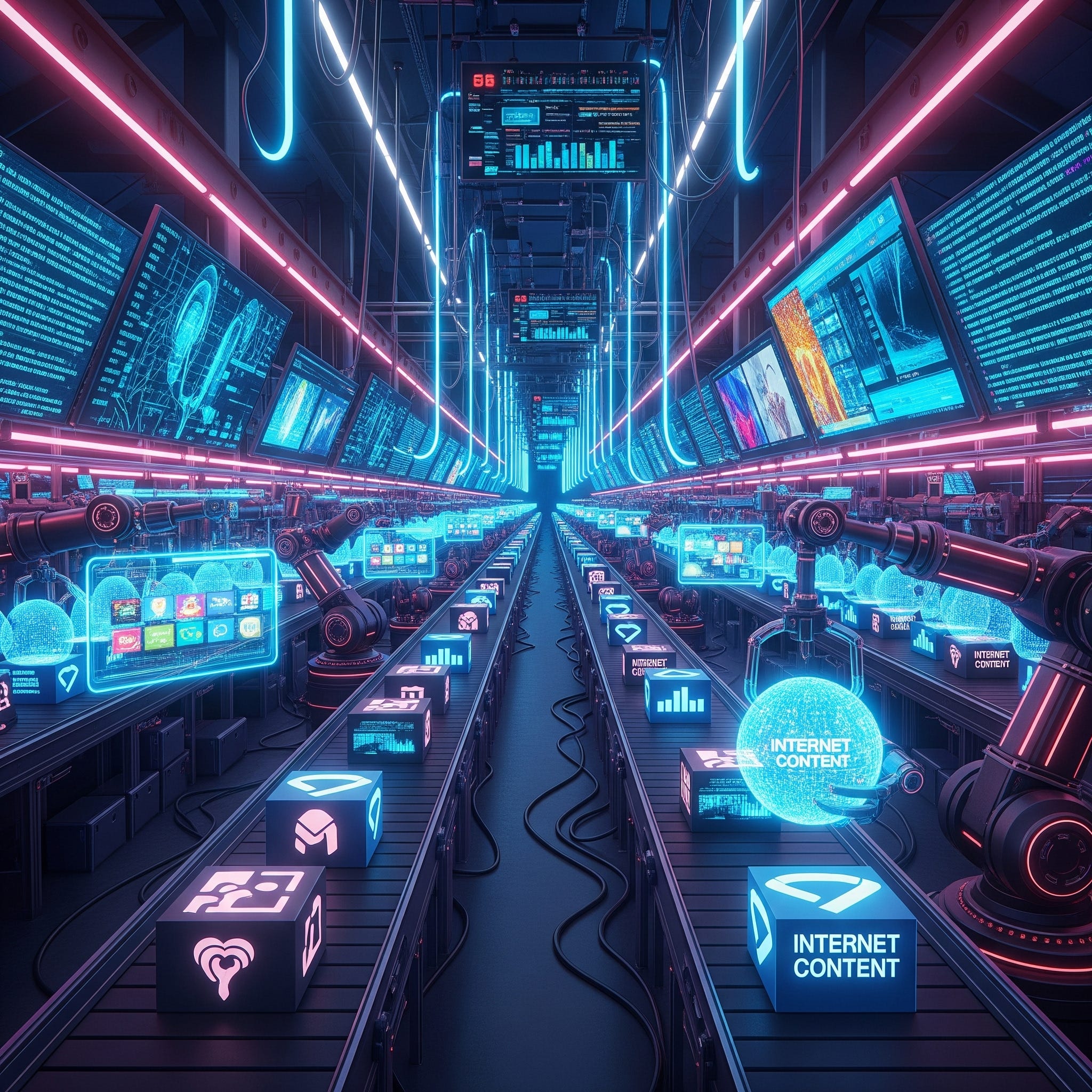
The fascination with handmade goods is hardly new but it means something different depending on the historical context. In 2026, handmade can refer to specific goods but artificial intelligence (AI) puts a fresh spin on the concept. Much in the same way that mass production made people harken back to the days of fine artisan, handcrafted goods, the age of generative AI is making people consider authenticity (i.e. “handmade”) virtual content. AI is enabling the mass production of graphic, written, video, and audio content on a huge scale all while automating its distribution. This kind of mass production of content is not that different from the mass production of goods or “crafts” that caused our village trinket salesman to differentiate his products from those off an assembly line.
Generative AI is moving quickly, and it is enabling a lot of efficiency and productivity across many different industries and verticals. It’s also starting to cause consumers to search for authenticity, originality, and “handmade” content. Comparing the mass production of goods to the mass production of AI generated content is a useful exercise as leaders, organizations, content creators, and researchers consider how to employ AI inside their organizations. The AI authenticity discussion is not about content creation. It also informs implementation strategies for leaders across industries. Generative AI can be a real competitive differentiator, but volume is not the answer. When considering enterprise generative AI deployments, many leaders think about efficiency and productivity and hopefully about privacy. Leaders should also consider the downsides to efficiency:
Lack of authenticity
Mass produced feel
Lack of character
These are the same issues that moved tourists to seek artisan crafts and reject the products of the assembly line, and they serve as a good reminder of how “efficiency” in certain areas of AI business deployment can harm competitive advantage.
Authenticity
Travelers often seek out unique, authentic experiences. In some circles, it would be sacrilege to admit that you were in a “touristy” area or that you went to what some might consider a tourist trap. Travel snobbery aside, this points to the desire to do something that’s not prescribed. Said another way, something that’s not mass produced and for everyone. One of my favorite things to do on travel is to find the artist sitting in the town square painting a local park or cathedral and buy something from them on the spot.
Mass production is a hallmark of the Industrial Revolution and brought many goods to people at an affordable price. No one would argue that we should not mass produce microwaves or cars or iPhones. The trouble is that the same process can be used to mass produce arts and crafts. Mass produced items can be passed off as authentic leading some consumers to question the veracity of the seller, hence the sign I saw in Sirince.
The authenticity of goods matters to many consumers. Even items like luxury clothing brands, jewelry, sports jerseys, and handbags carry a demand for authenticity, even though some of these items are themselves mass produced.
The truth is that most consumers want the authenticity of handmade at the price of mass produced.
Often, we forget what handmade really means. Regarding physical goods, handmade means that someone went to extraordinary lengths perfecting a craft and applied that craft meticulously. What they did was neither cheap nor fast. That kind of skill and craftsmanship should be rewarded with a higher price, and it often is. That means more unique goods but higher prices.
In the digital age, we have the same desires. Just in the last five years, graphic design, digital art, written word, audio, and video can all be mass produced. This has been a boon to content creators and to creating efficiencies in other industries. But the swing back toward “handmade” is already underway and it impacts how we implement and operate AI in multiple ways.

This article is not a deep dive into content creation and the pitfalls of a lack of authenticity, though those do exist. It is about looking at AI generated content creation as a canary in the digital coal mine. It’s an indicator that a fully automated and AI driven organization or even individual workflow may not be the right answer in every business case. The application of AI is already creating significant productivity increases in a number of industries, which should be recognized. However, applying AI to an organization’s true competitive differentiator can have an opposite effect. Figuring out the difference is going to be the key as more businesses implement AI in 2025. 2026 will be about refining use cases and building that productivity in the right places. The canary is getting quieter.
AI Slop
Last year, TV host John Oliver did a segment on “AI Slop” for his show Last Week Tonight on HBO Max. The show was about how the ease of AI content creation is contributing to an erosion of truth. AI generated videos, deepfakes, and other realistic content is being mass produced, and mass delivered to audiences that are struggling with how to detect the truth in online content. Some of this feels innocent like cute videos or generated photos to use on social media accounts. Other content has a malicious and deceiving purpose from deepfakes to supposed political messaging.
The point of the Last Week Tonight piece is that the creation of this content has become so easy that the “mass production” of it has flooded the market with multiple impacts including the erosion of the truth and legitimate content creators being pushed out of the market as they are unable to keep up with the pace of generated content.
The generative AI assembly line is the most efficient and fastest in history.
What’s the best kind of content? MORE content! This reveals that consumers of digital content have a nearly unending appetite for more. The revealing part is that even in an industry where more is truly more, there is pushback against the volume of incoming AI generated content pieces regardless of format. Business leaders thinking about AI deployments should think hard about this.
The AI slop story tells us that authenticity still matters. While consumers crave more content, they really crave more authentic content the way travelers try to avoid tourist traps.
How to Achieve Authentic AI Implementation
Using content creation as a case study is helpful because it provides an extreme example. The lesson, however, is that AI-enabled efficiency across the board may not deliver the value creation sought. Implementing AI should be about building productivity while preserving competitive edge. Every organization has something it does that it is best at. Something that defines the organization, its culture, and why customers come to them. Whether AI makes that better is not a simple “yes.”
Imagine a cybersecurity intelligence analysis company that produces intelligence reports for clients. That company likely has a significant amount of data in the form of cybersecurity incident data and previous intelligence reporting; a mountain of data that is just going to grow. Large quantities of data can slow down an organization if not properly managed, so this firm could use a large language model (LLM) to parse its previous reporting and other external reporting to enhance its analysis resulting in faster production and more accuracy.
However, the same firm could also choose to fully automate its entire report generation process based on automated data inputs. While this solution is absolutely feasible, it may not be desirable. On one hand, giving human experts better data-driven insights will result in better production and create more competitive advantage. On the other, the automation of the entire report generation process will result in a loss of what gained the company its customers to begin with: the unique insights of a well-crafted team of experts. This nuance is subtle but matters when considering AI implementation.
Automating PART of the process is different than automating the entire workflow. I use AI to generate images for my articles, but I never use it to write the prose. This is the same as the fictional cybersecurity analysis firm. Think in terms of augmenting humans to grow a competitive edge, not in terms of automating everything that is automatable.
There are many processes in organizations that could be more efficient. For example, hiring processes or sales lead generation can benefit from targeted automation. No manager would automate the entire hiring process, but efficiencies can be found.
2025 will be remembered as the year that smart organizations moved from strategy to implementation on their AI projects.
2026 will be the year that smarter organizations refine their use cases and automate processes that enhance their competitive edge.
Digital marketing is the canary. Many consumers seek authenticity in a market where more is more. There is historical precedent for this desire in other markets. Mass production works for some goods but not for others. The same will be true with implementing AI in businesses in 2025 and beyond. Automate the things that free your experts to do more critical thinking and that arm them with better insights. Automating them away entirely is a mistake. Enhance their productivity and maintain the authenticity that gave you your edge to start with.

The trinket seller in Sirince knew it then. Provenance matters. I’m sure he was (and likely still is) looking for ways to be more efficient and to increase his profits. But he knew that part of those profits was tied to his authenticity.
Want to hear the worst part? My wife doesn’t like sweet wine, so my attempt at a unique “sorry I missed a quarter of our first year of marriage” gift fell a little flat. But I’ve always remembered that sign.