
An FDIC Model can Create Assurance for Cislunar and Interplanetary Economic Missions
Part One of Our Series on Space Economic Assurance


The scene must have been terrifying.
On December 11, 1930, thousands of worried New Yorkers were queued outside a Bronx branch of the Bank of the United States. Men in broad brim hats stood uncomfortably close to women in full length dresses on the chilly December morning because they’d heard a rumor. The New York Times reported that a disgruntled merchant in the Bronx began telling people that Bank of the United States was refusing to sell its stock. The rumor spread throughout the city and throughout a largely unregulated and distrusted financial system leading its recipients to congregate outside the bank on Southern Boulevard as outnumbered New York policemen in their chin strapped helmets and polished brass buttons tried to maintain order.
The image of so many people outside a bank in 2025 is hard to imagine but each of us can empathize with those frightened depositors in 1930. The run on Bank of the United States may have been catalyzed by a rumor, but its cause was deeper. There was a question about how these people would be made whole. If the bank failed, what would become of their deposits? Their life savings? This fear permeated the United States in the wake of the Bank of the United States failure and aggravated the country’s slide into depression. Those cold and frightened people outside the Bronx bank branch in December 1930 were not the last to have this feeling.

The question of who intervenes in moments of catastrophic disasters lives on. Following the failure of the Bank of the United States and 9,000 other banks failed and the Great Depression took hold. Two years after the failure of Bank of the United States, the Banking Act of 1933 created the Federal Deposit Insurance Corporation or FDIC. The FDIC is a true cornerstone of the US financial system post-Great Depression because it provides some level of assurance to depositors that those queued in the Bronx did not have. It answers part of the question about who intervenes in a moment of crisis. If you have a bank account with $250,000 or less in it, your money is insured, not by the government, but by the banks themselves with the oversight of the government.
The concept of government oversight over non-government funds turned out to be game changing for the financial system and it provides some insight into models for the space economy. While the reasons and mechanisms will not be the same, an FDIC-like entity that insures significantly risky space economic activities will be critical as we expand into cislunar and interplanetary space. Disasters in space will be costly in terms of lives, materials, and investment and could, depending on the size of the project, bankrupt large space companies. Thinking about how such a disaster will be handled today, before one occurs, will prevent potentially devastating impacts to the economy broadly and to the space industry narrowly.
No one will be queuing outside a space company’s headquarters but that doesn’t mean there won’t be impacts. A cislunar insurance body akin to the FDIC model may be the answer.
The FDIC Model
The FDIC was built in response to over 9,000 bank failures between 1929 and 1933 and the resulting lack of confidence in the financial system. The initial crisis laid bare the fragility of the US financial system due to its largely unregulated and uninsured state. Bank failures today are rare but, in the years just before FDIC’s creation, they were shockingly common. The reasons for the failures varied but the baseline problem is that so many Americans had lost their life savings to bank failure that the lack of confidence in the system threatened to collapse the economy further than it already was at the time of the Great Depression. The creation of the FDIC was part of the answer.
Created in an era when the names of laws were not political statements, the Banking Act of 1933 (also known as Glass-Steagall) mandated the FDIC. The drafting of this legislation must have included some fascinating discussions over whose responsibility it was to make depositors whole after a bank failed. A quirk of a capitalist system is that failures of privately owned enterprises can pose threats to national, homeland, and economic security, requiring a government response. This has always been an issue with which the United States has grappled and continued to do so through the 2008 financial crisis. Phrases like “too big to fail” and “bailout” integrated into the chants of protestors and remain controversial to this day. But the drafters of the Banking Act had an idea. There was no doubt that depositors needed insured against the failure of a bank, but who would foot the bill?
Insuring deposits meant setting an upper limit for which someone could be paid back in the event of a failure. In 1933, that limit was $2,500. Today’s it’s $250,000. That means we need a pot of money to pull from, but who pays into it? The answer in the case of FDIC was that the banks themselves would pay in. The FDIC would collect and hold a pot of insurance money that was paid not by the depositors but by the banks. That money would be administered by FDIC and distributed in the event of a failure. In addition to these responsibilities, the FDIC also examines and supervises banks to monitor their financial health and requires resolution plans for the largest banks.
The entire history of what made the US financial system more stable is outside the scope of this article, but the idea of an independent government agency that administers an insurance fund paid by the entities it is overseeing is a lesson for the space industry. Activities in cislunar space and beyond will be extremely dangerous but hold promise for extreme profit. The history of capitalism suggests that these kinds of opportunities will not necessarily be approached with the utmost discretion. The scope and scale of these efforts alone demand that a conversation about who pays and who intervenes in the moment of crisis be had just like it was in the drafting of the Banking Act of 1933. Only this time, we have the opportunity to do it before the crisis.
Cislunar and Interplanetary Economic Value
According to the World Economic Forum, the projected value of the space economy by 2035 is $1.8 trillion, up from a previous estimate of $630 billion in 2023. The revision is mostly about the demand for services on earth that originate from low earth orbit (LEO) satellites. But the lesson is that estimates for economic value in space are highly subject revision, usually upward.
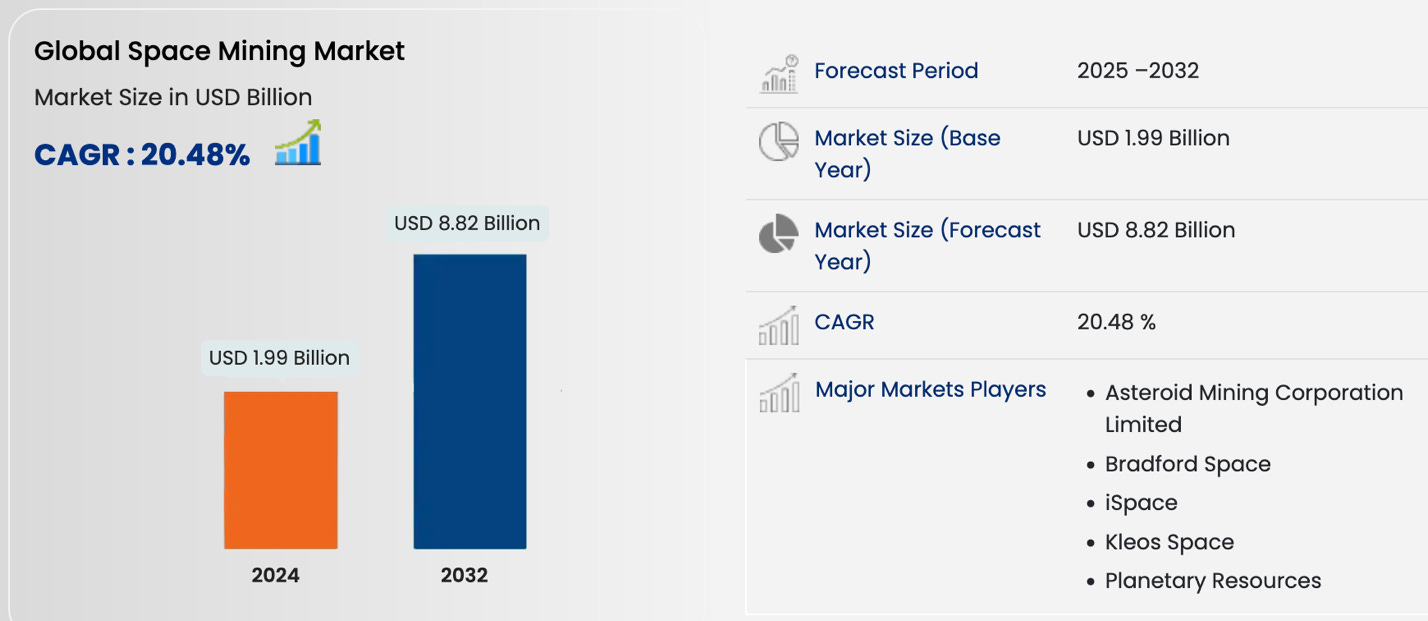
The estimates for the value of the cislunar economy are less clear but currently stand at $8.8 billion by 2032 on a 20.5% CAGR according to Data Bridge Market Research. This estimate is mostly for cislunar mining, but for the design and build of supporting equipment like autonomous prospecting and mining facilities. The exact value is unclear, but some estimates are shockingly high provided that there is a sustainable way to mine rare earth elements and return them to earth. A lot of technical and regulatory questions must be answered before this becomes reality, but the potential is there, and companies are already designing and building for this possibility.
To make space mining profitable, a company would need to establish a semi-permanent habitation on the entity being mined and perhaps include refining capabilities. This would mean moving large amounts of sophisticated equipment to the mining site to include
Life support for humans
Repair capabilities
Fueling
Communications
Position, Navigation, and Timing
Emergency Services
More
In short, it requires critical infrastructure. Moving this kind of equipment to space will not be cheap and the technical challenges will be massive. The payoff, however, could be huge and as we begin to understand the technical possibilities and economic demand on earth, the market is sure to take shape. Already, companies are building technologies for lunar and Martian activities in areas like habitation, mining, and infrastructure and those companies have raised funds. Examples include:
Astrobotic: Lunar transportation and delivery services.
Funds Raised: $315 million
Ispace: Lunar exploration company.
Funds Raised: $489 million
Redwire: High speed communications and navigation for cislunar space.
Funds Raised: $460 million
There are many more but just these three companies have raised a total of $1.26 billion dollars…with a B. While the value of the cislunar economy might not be certain, many people believe the value is there and the investment shows it.
The cislunar and interplanetary economy will require huge investment and that much concentrated capital also requires confidence. One of the lessons that catalyzed the creation of the FDIC is that thinking about response to crisis before it occurs is important and the space industry has that opportunity. It also needs to consider whose responsibility it is to foot the bill for a response and recovery effort. If private companies are undertaking this risk, they cannot expect governments to come to their aid.
Check back next week for part two of our series on creating assurance in the cislunar and interplanetary economy.