
Deep Sea Mining is Really Hard. And the Tech is Expensive.
Part I of Our Series on Deep Sea Mining

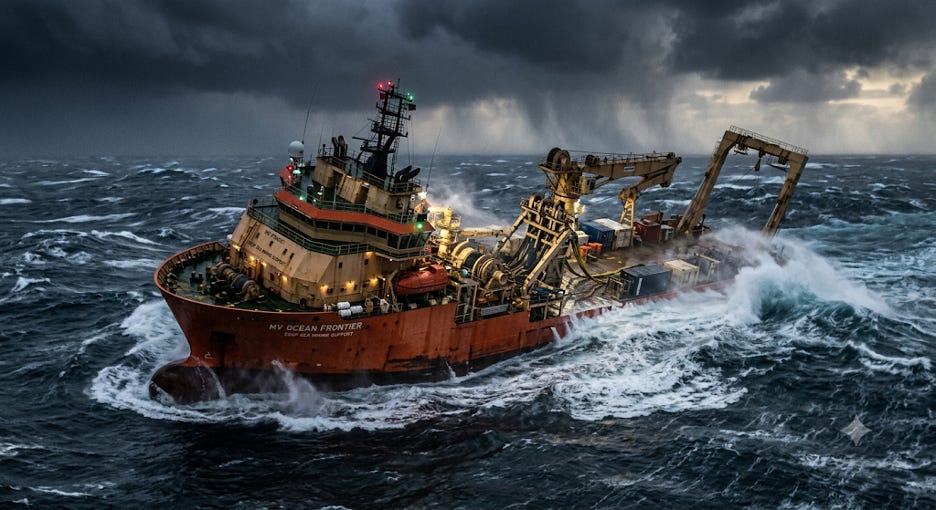
“You joined the navy to see the world? Well, the world is 70% water, so you will see a lot of it.”
From a crotchety old navy chief with more time at sea than I’d been alive came this response following my youthful complaints about not visiting more ports on our upcoming deployment. It was 2003 and we were preparing to depart for what would be participation in Operation Iraqi Freedom aboard USS Iwo Jima (LHD-7). The $1.6 billion warship had been my home for the last 18 months as a poor 18–19-year-old figuring out life that did not include parents or high school sports. September 11, 2001 happened just after I graduated boot camp meaning that my perception of what my navy career would be, pretty girls on foreign beaches, was quickly replaced with the reality of live military operations in the Persian Gulf.
By conventional measurements (i.e. number of countries visited) I’ve seen a lot of the world. By the measurement of my less-than-friendly chief mentor, I’d seen even more. I would often remark to my friends and family that you can always tell where you are in the world by the color of the water. I remember well the first time I opened an exterior hatch and walked out onto the ship’s weather deck to find only ocean of the brightest blue I’d ever seen. It was the Gulf of Mexico, and the sun beat unimpeded by clouds upon me as my eyes squinted having grown accustomed to dark, blue-lit rooms. From that moment, I always loved being at sea, though I loved the rotating midnight shifts I worked significantly less. But that’s been part of the human experience at sea since time immemorial, a conflict between its beauty and its danger. Between its solitude and those at home you miss dearly. Between the privilege of seeing a lone breaching whale surrounded by nothing by vastness and paying the price of prolonged wakefulness.
Most humans find the oceans a combination of beautiful and frightening. There are those today that see profits. Profits to be had at the bottom of the deepest and darkest abyssal plains in the world.
Mining has been a human pursuit for as long as humans have understood how to use natural materials to make things useful to them. The earliest forms of mining involved simply picking up specific rocks from the ground before we realized that we could dig under the earth and find even more. But mining has also come with social and societal impacts that leave current humans looking for ways to get the materials we need but not send other humans underground to do so. One such suggestion is deep sea mining.
Deep sea mining is difficult on par with mining on the Moon or Mars but its location on this planet makes it deceptively attractive as a relative easy button for our energy and material woes. However, what it really takes to mine several miles under the open sea is another matter, one that deserves examination before significant investment and policy build the foundation for something many don’t fully understand.
Keep reading with a 7-day free trial
Subscribe to The Binary Breakaway to keep reading this post and get 7 days of free access to the full post archives.