
The AI Infrastructure Party and the Green Light Across the Bay
Are you a Gatsby or a Caraway?

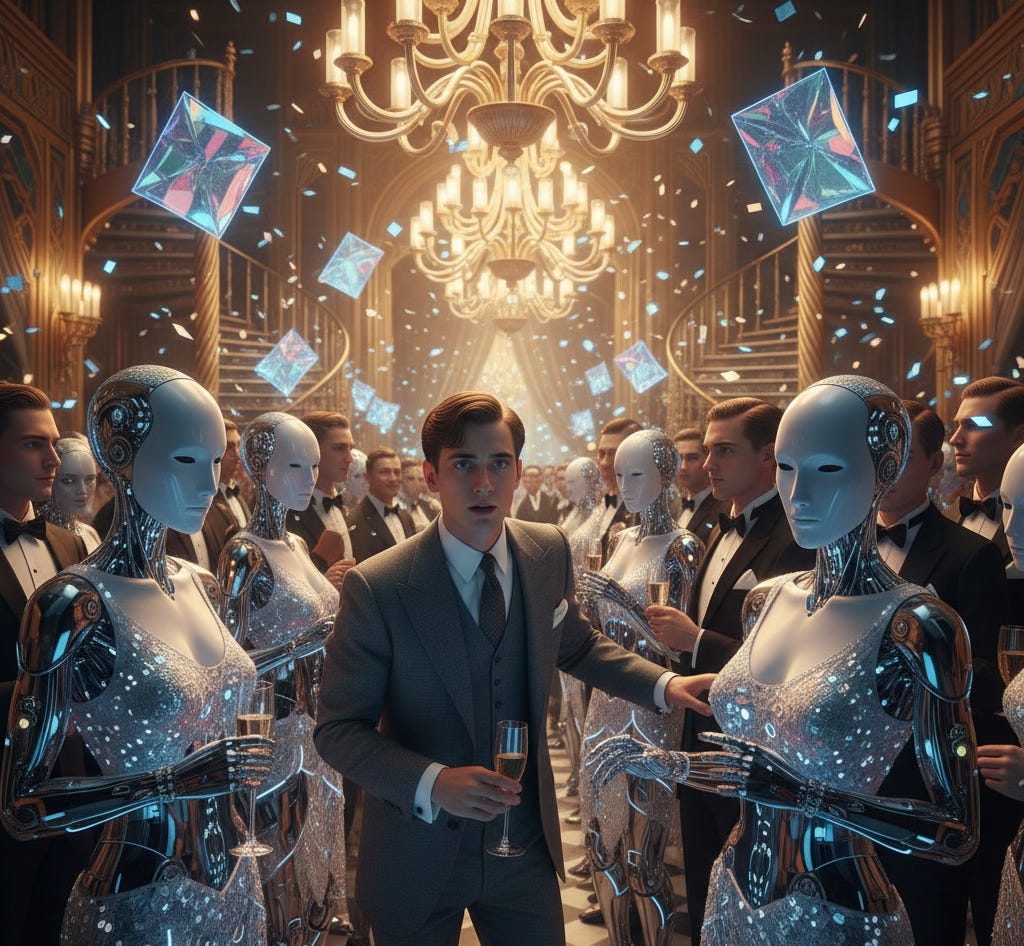
Nick Caraway pushed his way past partygoers that scarcely noticed him bumping into them. They certainly would have had any of their French champagne spilled down the front of their custom cut suits or sequined dresses. The drunken laughter competed with the band in what turned into a raucous cacophony that only Jay Gatsby could muster. In the 1920s, in West Egg New York, the mansion parties of Jay Gatsby were the place to be. If you missed one, don’t worry. He held them all the time and his neighbor, Nick, was endlessly curious about them.
Nick was not of New York high society as those around him were. He probably couldn’t tell the difference between the champagne Gatsby had flown in and what he may have had at as a celebration a few years ago in his Midwestern home. His clothes certainly betrayed his standing relative to those around him. Everyone seemed to speak of Jay Gatsby as if they were close friends, by Nick never saw him. The parties were over the top at a mansion on the bay. Just across the bay from Gatsby’s dock was a green light. The light at the end of a dock in East Egg, the old money part of town. The green light was not only a signal that drove Gatsby in terms of status, but in terms of his love pursuits. That light, always visible from the Gatsby mansion, belonged to the home of Daisy Buchanan, the wife of a conservative old money figure, Tom. Gatsby’s pursuit of Daisy and of the status that comes with being considered “new money” instead of “old money” was his undoing. When Gatsby died, none of the partygoers that Nick Caraway pushed past were there. The mansion sat empty, staring across the bay at the green light that Gatsby never reached.
Trying to navigate the artificial intelligence (AI) world in 2025 feels like being Nick Caraway during a party at Gatsby mansion. There is opulent wealth everywhere, people, companies, and investors dancing to the music and drinking the best champagne. But the astute observer will think like Nick Caraway, not like Jay Gatsby.
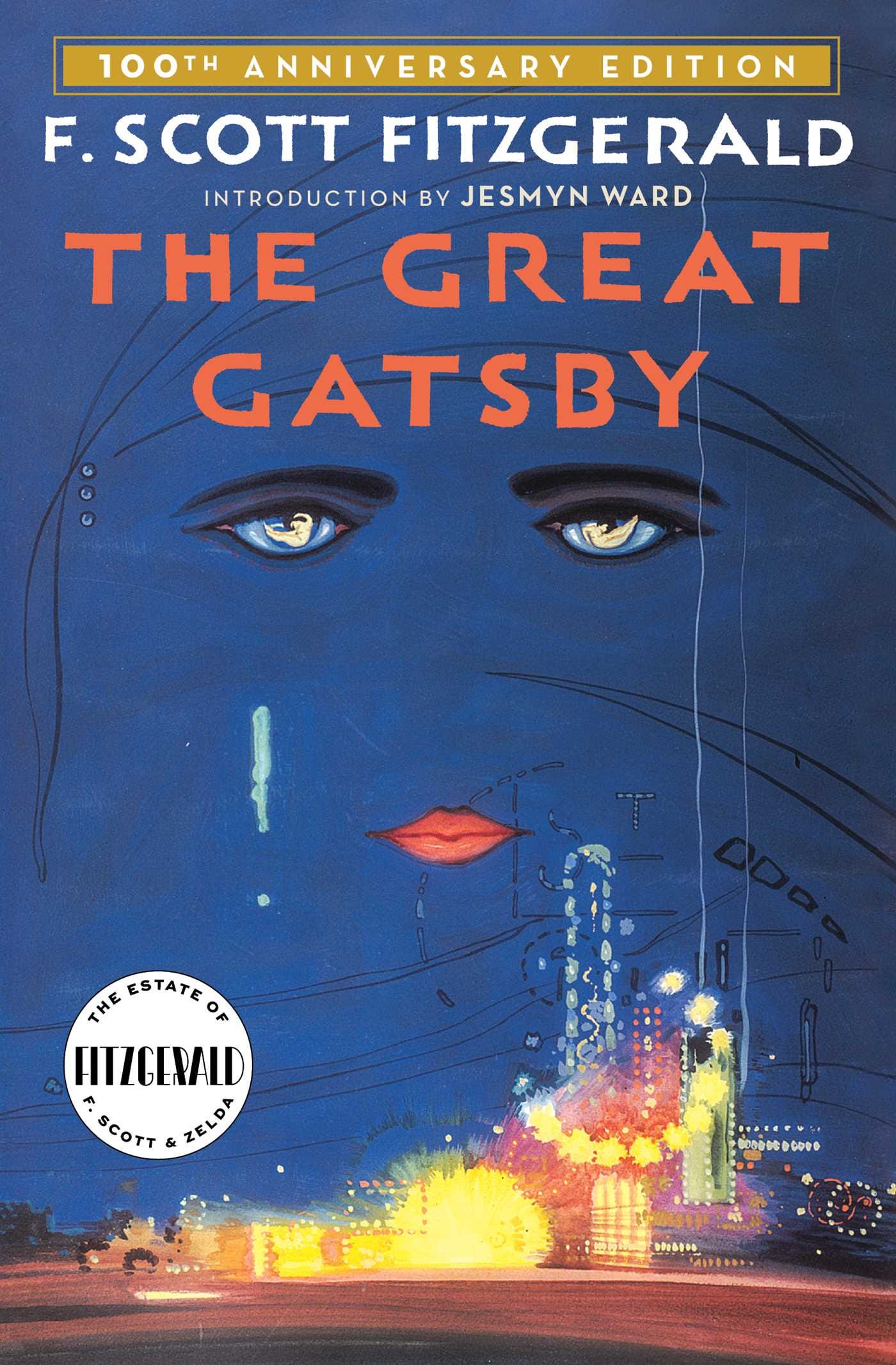
Since last year, analysts and news outlets have posed the question about whether there is an AI bubble, and if there is, what it means for the economy and for the tech industry. Sometimes we spend too much time trying to predict the future that we forget that there are lessons in our past. The story of Jay Gatsby is an American classic that has resonated with audiences for 100 years not because of its humor or connection to New York high society, but because of what it tells us about speculation, the façade of wealth, and the fall.
AI companies are seeing a green light across the bay. That green light is the promise of artificial general intelligence or AGI. The industry has built a mansion across the bay and is building ever more and throwing bigger parties to move closer to the light. But the industry is showing signs of a façade of wealth, which might leave the trillion-dollar data center as empty as Gatsby’s mansion.
Fragile Wealth
There must have been a moment when Gatsby launched his plan. He knew he wanted to pursue Daisy (the green light across the bay) and he could only imagine, based on her choice of husband, that lavish wealth, and proof thereof, was the answer. The guest list had to be carefully curated, and the catering had to be impeccable. No expense would be spared because no detail could be missed. It was a long-term strategy, an investment in his ultimate goal. It didn’t matter where the money came from. As Jim Williams says in Midnight in the Garden of Good and Evil:
Yes, I am nouveau riche, but then it’s the riche that counts, now doesn’t it?
Gatsby didn’t set out upon this endeavor under the assumption that the wealth he had would crumble before him. The goal was to use his new, and of questionable provenance, wealth to propel him into a stable position in society, and into the arms of Daisy permanently. He set out upon this course believing that he was on the right path. Those around him were more than happy to believe in him as well, just as long as the parties continued. Once Gatsby was in trouble, there was no more dancing and party. Just an empty mansion.
In 2026, we can think of Daisy as the pursuit of AGI and the infrastructure build as the mansion parties. Famously, many AI companies are involved in a circular economy where Company A buys products or services from Company B, which is financed by Company A’s investors. The fragility in that system alone is striking not to mention the stark differences between infrastructure debt and annual recurring revenue. Last year, OpenAI was revealed to have $20 billion in ARR against $1.4 trillion in infrastructure commitments. OpenAI is also a member of the circular economy while occupying a top spot in the S&P 500. A failure by OpenAI to pay its debts will have immediate impact on the stock market, but there is contagion on the horizon.
OpenAI has deals with AWS ($38 billion over 7 years), Oracle ($300 billion over 5 years), and Microsoft, which is also an investor in OpenAI ($250 billion over multiple years). US chipmaker Nvidia announced a $100 billion investment in OpenAI, which OpenAI will use to buy Nvidia chips in the most egregious example of the circular AI economy. All of this is fragility. Fragility of the tippy-top of the S&P 500, the high society of the stock market.
These circular investments and massive infrastructure deals are the mansion on the bay, all being built in pursuit of the green light across the dock, AGI. Whether we reach AGI is still an open question, but that has not stopped the largest AI companies from burning cash like it is a foregone conclusion. Also a foregone conclusion: Gatsby’s marriage to Daisy.
Empty Data Centers
If we imagine a world where OpenAI or other AI companies at the top of the S&P 500 falter, there would be a massive economic crisis. Perhaps worst hit will be the creditors that underwrote the debt that AI companies and their investors took out to create the circular economy with defaults impacting the banking sector.
The chips sector would be impacted directly as the demand for high powered GPUs, currently sky high, comes back to Earth. There would be ripple effects in R&D expenditures for advanced computing, next generation security, and new hardware as the economic opportunities dry up. Both chips and advanced computing R&D have direct geopolitical implications, and the consequences of a burst AI bubble would set both back years while the economy settles.
The energy sector is seeing a huge resurgence as the demand for electricity to power the planned gigawatt data centers is growing. An AI bubble burst would impact the energy sector and the new infrastructure it is building. Those costs could be passed on to customers as empty power generation plant are about as profitable as empty data centers, raising energy costs across the board. This kind of impact would exacerbate worsening economic conditions.
The US could turn into a sprawling monument to speculative investments with wealth of questionable provenance. A graveyard of collections of advanced computing, chips, and electrical plants that were once thought to be the key to AGI.
The failure of the current AI infrastructure push is not sealed, but there are reasons to be concerned.
The circular AI economy
The assumption that demand for Nvidia chips is unending
The $500 billion Stargate investment is separate from the $1.4 trillion in commitments that OpenAI has on the books
AGI is assumed to need much more compute, but the amount is unknown as is whether AGI can be achieved with traditional computing at all
The result could be cavernous data centers sitting idle. Some draw the parallel with the dot com bubble and how companies laid fiber optic cable much too early. Those cables were eventually used, and the companies were able to recuperate those initial losses, the ones that survived anyway. The AI bubble will likely not be the same. We do not know for sure that AGI is achievable at all. By extension, we don’t know if it is achievable on traditional computing. It’s entirely possible that we may need to explore biological computing to get to that level. If that ends up being true, and there’s good evidence that it might be, those data centers will rot. No recovery of expenses in a decade. Just money down the drain.
At the end of the story, Jay Gatsby is dead in his pool next to Myrtle’s widower. After his death, all the people that so willingly drank his champagne and danced to the band he hired were nowhere to be seen. All that was left was an empty mansion built by questionable funds with a perfect view of the goal it could never achieve.
There are a lot of Gatsbys in the AI industry right now. Be a Caraway.