
We Need a Quantum Genesis Mission. How Much Would it Cost?
Less Than 10% of AI’s Bill Buys us Sustained Quantum Leadership

Someone in the room definitely had a marketing degree. Or they at least had some marketing sense.
If you want to get the attention of average folks to showcase what you are doing on artificial intelligence, here’s the formula:
A national rallying cry to create urgency
A snappy name that blends a biblical reference with starting something big
Frame it around competition with an adversary
Use the term “mission” to invoke images of Apollo
Shake well and you get “Genesis Mission,” the Trump Administration’s plan to make AI data and resources available to developers of all shapes and sizes. The intent is noble. Democratize the heavy compute and data resources required to do real AI and machine learning to expand development to more people to help the US broaden its lead globally. The call to action began the week of Thanksgiving and soon the Department of Energy launched a snazzy single scroll website with dark tones and plenty of big-name partnerships. The Genesis Mission was underway.
2026 will tell the story of the Genesis Mission because while the executive order made big claims, it provided exactly no money to launch this massive national effort. What’s more, it demanded the Department of Energy and the national laboratories lead the effort, the very same agency that took a 20% hit to its workforce and a 26% cut to its non-defense budget (which would include at least part of Genesis) in 2025. The outlook for Genesis isn’t great as of this writing. Perhaps 2026 will surprise us, but given the current track record of this Congress and that 2026 is a mid-term year, no one should hold their breath.
The idea of a major national effort around a major emerging technology was not a bad idea and the branding was right on target. The problem is that the designers of Genesis aimed it in the wrong direction. The Genesis Mission aims to grow infrastructure for AI, an effort that’s already well underway in the private sector. The unfortunate opportunity cost of Genesis is that if the government really wanted to make a difference, it would have unified us around quantum computing. AI is here. Quantum is on the horizon, and its impacts could be far greater. It’s a technology that’s not well understood but garners heavy investment globally at a time when investors and analysts are asking whether there is an AI bubble. The “moonshot” the government is calling for is aimed in the wrong direction. We need a Genesis Mission for quantum.
The Quantum Industrial Base
Some perspective:
In 2025 alone, investment in AI infrastructure was around $400 billion.
Over $1.4 trillion is committed by a SINGLE COMPANY to build more AI infrastructure.
Since 2018, the US National Quantum Initiative has been allocated a TOTAL of $1.8 billion spread across multiple agencies.
Take it away, Michio…
Extraordinary spending on AI infrastructure has become so commonplace in emerging technology circles, that many don’t question it. The $500 billion Stargate investment in early 2025 set the tone and the pace (and Nvidia’s stock price) has increased since.
But let’s be honest with ourselves. The time to build this infrastructure was in 2020. Kicking off plans to scale AI infrastructure in 2025 was late. We should not make this mistake with quantum.
The gap between spending on AI infrastructure and quantum infrastructure is so vast, calling it a “gap” hardly does it justice. Private companies are by far the biggest investors in quantum technology, but by its nature that means quantum development is siloed and driven by market opportunities (and oftentimes market hype). The first problem a quantum Genesis Mission could solve is to centralize production of quantum materials like qubits, standardize them, and optimize them for precision. The creation of the first quantum foundries.
Quantum foundries would be costly and the standardization problem is one that the private sector is not going to solve if left alone because there’s no economic incentive to do so. Look how long it took Apple and Microsoft to be closer to interoperability. We don’t have that kind of time. About $8 billion should get us 2-3 of these foundries, FAR below the AI investment pace.
We for quantum, we are in a moment when building the infrastructure now would payoff huge. This is the kind of strategic move that would set the US ahead in an entirely new type of computing and accelerate our transition to post-quantum cryptography, an area where the US has been notably slow. There are security as well as economic implications to this investment. And for those of you keeping track at home, the already spend $1.8 billion plus $8 billion for our foundries has us at $9.8 billion. That’s $390.2 billion under budget relative to our AI builds.
A Strategic Reserve
I was once asked on stage at a speaking event if we could put quantum computers in orbit to help keep their temperatures as cold as we need them. The answer is that it’s not cold enough…IN SPACE.
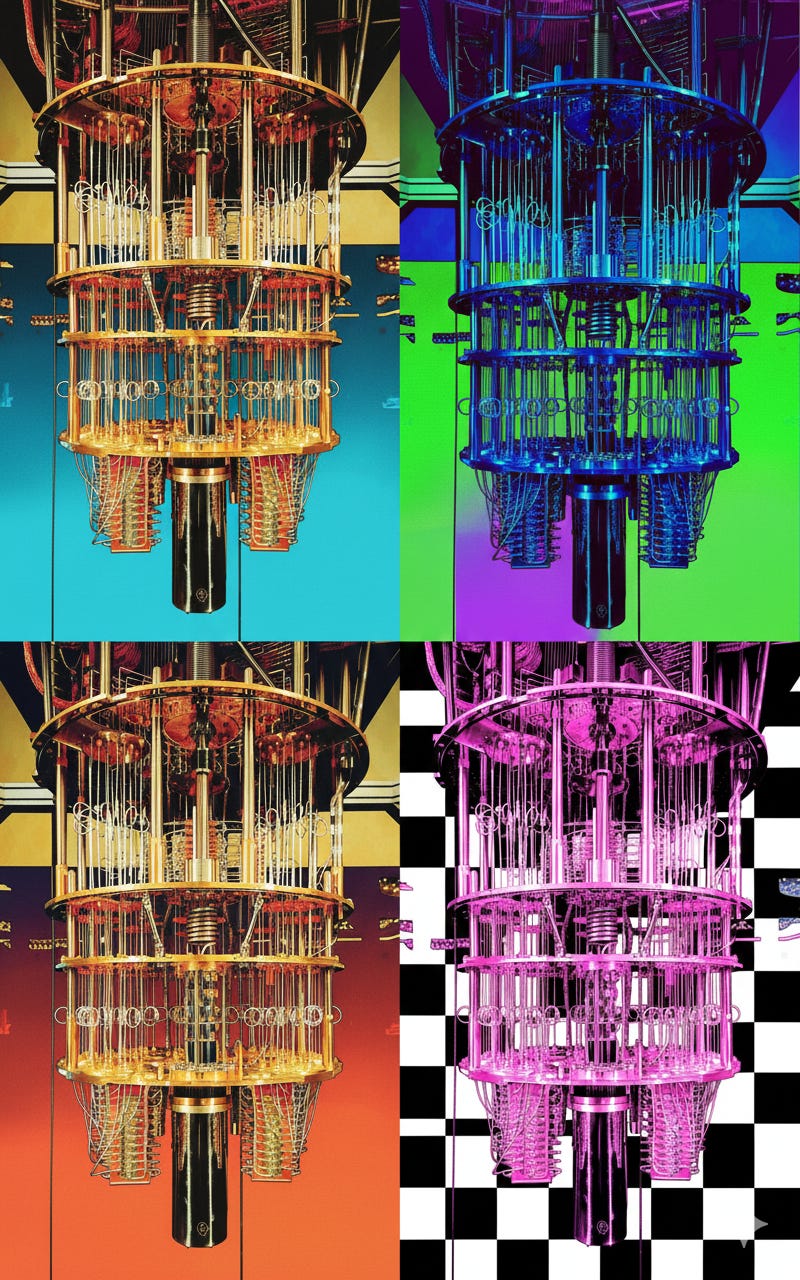
Quantum computers require a cold that is hard to imagine. This is because at just a fraction of a degree above absolute zero, qubits finally start behaving. To achieve this level of cold, we need a supply of Helium-3, a stable isotope used in dilution refrigerators. Helium-3 is currently provided by a limited number of suppliers globally, making its supply volatile. A quantum Genesis mission could stabilize the global supply chain and create a strategic reserve of Helium-3 (also useful for nuclear fusion). It could also create advance purchase agreements with US companies to produce dilution refrigerators on a massive scale. This gives the quantum foundries an important resource for their qubits and the infrastructure development companies need to achieve economies of scale for the extremely complicated cryogenics required to operate quantum computers.
The US can’t afford to stockpile everything, but something other than oil would be a great step forward. What we need to stockpile today is different than the 1970s like rare earth elements and Helium-3.
A good estimate for this portion of the mission would be about $4 billion. Having already spent $9.8 billion, this brings out total to $13.8 billion, $386 billion under the single year spend for AI infrastructure.
Quantum Workforce
We need people to invent and refine all of the inputs to the infrastructure detailed so far. The true long-term investment is in workforce. This is less exciting to venture capital and private equity but is the ultimate enabler of continued value in quantum computing. To do this, the government has an incredible and proven path to building a sustained quantum workforce.
The federal government could expand the National Quantum Initiative to create the first Quantum Corps. This umbrella program could be used to offer scholarships to individuals that wish to study quantum engineering. The government could also offer paths to citizenship for foreign quantum talent to ensure that the US retains the talent it spent money training.
Further, NIST could standardize a quantum engineering core curriculum necessary to be a recipient of Quantum Corps scholarship funds. Today, the basic curriculum for many engineering disciplines is the same across campuses with opportunities to branch out into specializations. For quantum, those specializations could include:
Quantum communications
Quantum foundry
Cryogenics
Quantum hardware manufacturing
Photonic quantum engineering
Quantum cryptography
Quantum algorithm programming
In addition to the PhDs, the quantum industry would need administrative, sales, legal, and managerial positions to create a functioning economy. Avoiding any accusation that the Quantum Corps only benefits those that can afford to invest in a PhD program, it could include elements like:
Quantum workforce development materials (customized by field)
Quantum curriculum for K-12
Quantum training for Teach for America and AmeriCorps
For those of you keeping track at home, let’s say this piece costs $8 billion. Our total is now $21.8 billion, $378 billion under the single year spend for AI infrastructure.
And just so no one accuses me of cherry picking the cheapest options to make a point, let’s add another $15 billion for the build of a quantum internet to network the quantum foundries and research facilities. That’s a grand total of $36.8 billion, $368.2 billion under budget.
The Best Time to Plant a Tree is 20 Years Ago
The oft quoted idiom rings true for emerging technology broadly. If the Genesis Mission (then named NAIRR) would have gotten off the ground in 2019 when it was first envisioned, the infrastructure would have already been in place when the AI wave really hit 2 years later. Instead, we are building the infrastructure 3-4 years AFTER the wave. In telecommunications, the US approach to 5G was significantly behind and only accelerated after China had already built their infrastructure, some of which was on US soil.
The argument might be made that AI is commercialized now and has a product-market fit now. That’s true, but it’s the wrong answer to the wrong question. When building infrastructure, the measurement we are using is not whether the technology is economical TODAY. Infrastructure is an enabler and, in some cases, a necessary foundation for technologies to progress. Quantum is an excellent example because of the incredibly specific hardware required to make it work. Much like a massive data center, most organizations can’t afford to create their own Helium-3 reserves or scaled quantum foundries.
AI being at the utility stage and quantum being at the foundational stage is not a reason to focus on AI, it’s a reason to focus on quantum.
This is not a suggestion for a federal government takeover of quantum research; it’s a call to unify the quantum mission. Create the enabling infrastructure that will allow the US to maintain a real lead in quantum across disciplines. The final bill for the program proposed above is just 9% of what we spent on AI infrastructure in a single year. That’s an investment that’s easy to justify given the payoff.
The Genesis Mission might not turn into what was envisioned, but they got the branding right. If we can hire the same branding person and put less than 10% of the budget toward a quantum Genesis, we will see the benefits for decades across sectors.
Great point about how building a sustainable quantum workforce is dependent in part on the accessibility of quantum education, especially in K-12. Getting people interested in/aware about quantum from a young age would pay off greatly in the long run both on the technical and policy sides.