
What Hath Anthropic Wrought?
AI Testing is AI Infrastructure

Samuel Morse sat in an overstuffed chair inside the ornate Supreme Court room in the U.S. Capitol on May 24, 1844. For the first time in history, Morse was about to have a conversation with someone miles away faster than the speed of horse. His assistant, Alfred Vail, sat nervously in Baltimore 38 miles away on the other end of the first ever telegraph line. But before this historic moment could get underway, Morse had a promise to keep.
Annie Ellsworth, the daughter of the U.S. Patent Commissioner, had run to tell Morse that Congress had passed the funding bill for his project weeks before. In return, Morse told Ellsworth she could pick the first phrase to be sent over this line.
•−− •••• •− − •••• •− − −−− −•• •−− •−• −−− ••− −−• •••• −
Ellsworth was a religious woman, and she chose a phrase from the Bible verse Numbers 23:23. Words she felt captured the enormity of the moment.
What Hath God Wrought
The phrase hits modern ears with sense of fright or the onset of an omen though this is not how it was used in the Bible nor by Ellsworth in 1844. The word “wrought” is an old world past tense of the word “work” or “made” so the original meaning of the phrase was more like, “Look at what God has done!”
This is how Ellsworth meant the phrase. Look at this amazing thing that is being done and thanks to God for it.
Its modern ominous meaning has adhered to the development of technology since the nuclear age. Thinking about the development of nuclear weapons, artificial intelligence (AI), or advanced biological sciences, the phrase seems apropos. But even if we step outside the development of weights and parameters inside large language models (LLM) we can find a place for this phrase in our vocabulary.
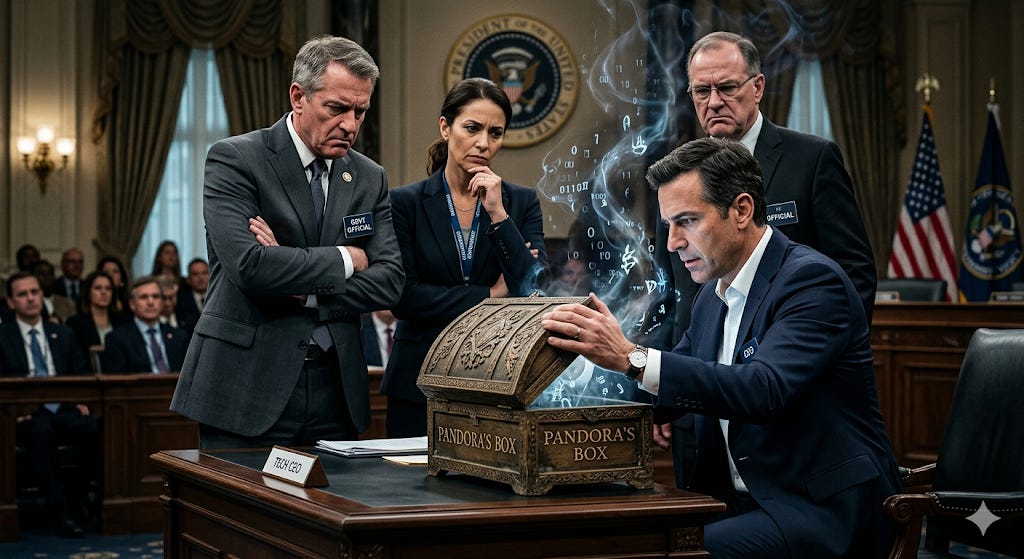
Since February 2026, AI company Anthropic has been in control of the narrative around AI development, ethics, and use. It’s very public row with the Pentagon followed closely by its proclamation that its Mythos model was too dangerous to release publicly has opened a Pandora’s Box of after-effects that may even have the leadership of Anthropic using Annie Ellsworth’s favorite phrase.
A Trump Administration previously ardently opposed to any real or perceived interference in AI development has suddenly broken the seals with an executive order and most recently the export control of Anthropic’s newest model, Fable 5. Anthropic made the connection between AI model development and existential cybersecurity threats and that connection has changed the face of AI development.
Samuel Morse and Alfred Vail sat 38 miles apart with a wire between them. Anthropic is sitting on top of some of the most powerful pieces of technology in human history and has found a way to get them export controlled. As the internet collectively groans over the Trump Administration’s decision, many of these Tweets are missing two critical points:
The lack of AI testing and assurance is a direct hinderance to AI innovation
Export control processes should be understood as AI continues to grow
Morse, Ellsworth, and Vail ushered in a new world of communications that changed nearly everything about human history. AI is doing the same. If we don’t get our arms around ways to test AI and be able to justify why export control decisions like this were made, we will find ourselves in the next cycle of an AI winter.
Export Controls
Even the most engaged American history student could be forgiven for missing the Export Control Act of 1949’s place as a significant historical law. Prior to 1949, export controls (dating back to 1774) were swung like a blunt instrument in response to wars and national security threats. The process was formalized in 1949 but the how we do export controls today, and the legal authority to do it to Anthropic and Fable 5, is not stuck in the post-WWII era. Export controls were amended in 1979 with the passage of Export Administration Act and again in 2018 with the Export Control Reform Act (ECRA). On a legal timeline, this is lightning speed and it showcases the importance of formalizing and continuing to revise how export controls are done. Why? Because the implications of swinging them like a blunt instrument are huge…and understanding why the Fable 5 issue is really about AI testing depends on understanding this process.
Under the current legal regime and incorporating all the learnings of export controls dating back to the late 18th century, this is how the process works:
Technical Evaluation ➔ Interagency Review ➔ Multilateral Alignment ➔ Public Rulemaking
Step 1: Technical Evaluation & Triggers
The process to control a new product or technology is usually triggered by one of three things:
Technical Progress: The Department of Commerce’s Bureau of Industry Security (BIS) technical advisory committees recognize a breakthrough in civilian technology that poses a novel military or intelligence risk.
Statutory Mandate: Under ECRA, BIS must continuously hunt for “emerging and foundational” technologies that aren’t yet categorized but are strategic.
Foreign Availability: BIS must evaluate whether the item is already widely available from other countries. If China or Europe already mass-produces the exact same technology without restrictions, a US export control is legally deemed ineffective and damaging to US industry, unless overridden for critical national security.
Step 2: The Interagency Review
Before a rule is written, Commerce must run the proposed control through an interagency clearinghouse.
BIS must build a consensus with the Department of Defense (DoD) (focusing on military utility), the Department of State (focusing on foreign policy and international treaties), and the Department of Energy (DoE) (if nuclear/energy implications exist).
If there is a dispute it is escalated to an interagency committee and can go all the way up to the Cabinet or the National Security Council (NSC).
Step 3: Multilateral Alignment
Historically, the US rarely imposes major controls unilaterally because American companies would simply lose market share to foreign competitors. Therefore, once the US interagency agrees on a control, they take it to international, multilateral export control regimes to get allies to match the restrictions.
Wassenaar Arrangement: For dual-use goods and conventional arms.
Missile Technology Control Regime (MTCR): For delivery systems capable of WMD transport.
Australia Group: For chemical and biological weapons.
Nuclear Suppliers Group (NSG): For nuclear-related dual-use items.
Step 4: Public Rulemaking and Final Codification
Once a technical threshold is agreed upon, BIS drafts a regulation published in the Federal Register.
Except in urgent national security emergencies, BIS issues a Notice of Proposed Rulemaking, allowing tech companies, university researchers, and the public to submit comments warning about unintended economic consequences.
After reviewing feedback, a final rule assigns the item a specific 5-character Export Control Classification Number (ECCN) and places it officially onto the Commerce Control List (CCL).
Reviewing this process, even a casual observer of the Fable 5 issue can see there are some gaps between what is statutorily required to happen under ECRA and what did happen. First, foreign availability. It can certainly be argued that no foreign countries manufacture AI models as powerful as Fable 5, but other countries absolutely manufacture AI models. For the VAST majority of model users, they are not looking for power on the level of Fable 5 but rather for everyday help. The harm to US companies from this decision stems from this gate in the process.
Second, the interagency review process. I’ve personally been a part of multiple interagency review processes for multiple things, and they are scarcely known for being quick. The reason this one was quick is that there wasn’t much to review. This is where the AI testing issue takes center stage.
Without consistent and standardized testing methods specifically for AI, making national security determinations that lead to export controls is an empty process and looks much more like magic wand waving.
No one is saying that we shouldn’t have review processes for major technologies like AI. No one is saying that there is NO CIRCUMSTANCE under which a decision like this might be made. What is being said under all the angry tweets is that there must be a reason for doing so that can be demonstrated consistently. This is the core of the problem. Yes, the decision upset many non-Americans. Yes, the decision likely hurt Anthropic. Yes, it is possible the decision accelerates sovereign AI and yes there are a multitude of unintended consequences from all these. But the remedy is not to simply repeal the order nor is it to throw caution to the wind and allow Fable 5 free passage the world over. The answer is prioritizing AI testing.
Anthropic’s Gambit
Anthropic’s effort to supplant OpenAI as the synonym from generative AI has taken many turns. Some accused the company of inflating the threat of Mythos as a means to position it for IPO in the wake of the loss of the Pentagon contract. If that’s true, Anthropic’s choice to serve the fear narrative to the world when it was starved for AI assurance could prove costly. Already, Anthropic can be argued to hold sole responsibility for moving the Trump Administration from its concrete position of non-intervention in AI to directing export control of its most cutting-edge model. Pulling Fable 5 off the global market will have economic impacts beyond Anthropic itself but it also established a precedent that will be difficult to unwind. The government has chosen this course without anything that can reasonably be called standard and repeatable testing, the results of which were then analyzed and determined to pose a national security risk. Instead, it acted on some concoction of vibes and buzzwords like “jailbreak” and “cyber threat.” The government swung into action and used statutory authority it possesses to halt the release. This is the consequence…the What Hath Anthropic Wrought moment.
Anthropic’s gambit of pressing the fear narrative could have ended very differently. Had Anthropic accompanied these claims with announcements that it was funding or had funded a program of rigorous AI testing, it would have cut the government’s actions off before they started. Had Project Glasswing instead been a testing effort rather than a conglomeration of other billion-dollar companies, the Fable 5 story would have ended differently.
The problem is that for too long, AI testing and assurance were seen as red tape, as blockers to innovation. Instead, Anthropic’s own actions have revealed them to be the true definition of AI infrastructure. AI infrastructure, in the hardware sense, is the infrastructure that enables AI models to be trained and used by millions. The fate of Fable 5 is that it is trained but not being used by millions of eager users. Had Anthropic had AI safety and assurance infrastructure in place, this would have been prevented. The ultimate AI enabler.
Fable 5 is the outcome of a fear-based narrative about a product not coupled with testing and assurance. Small wonder that AI users trust more advanced models less than early models that were less accurate. As we’ve built models to be more capable, we’ve ignored the need to ensure they are performing. Not performance in the sense of how many tokens they use or how fast they are. Performance in the sense of testing against edge cases, preventing harms, and protecting national security. If the government is to evaluate AI models, as the Trump executive order states, it must have standardized testing to evaluate all models regardless of maker or input.
Anthropic hath wrought some of the most advanced models to date that are doing amazing things. In that pursuit, it also hath wrought government intervention from a previously non-interventionist Administration. In so doing, it has proven that AI testing and assurance is AI infrastructure and without it, we are assured of unintended consequences.