
Math, History and the SpaceX IPO
Trillion of Dollars, as Many Questions

It hardly makes me unique among American youth that I did not take to mathematics in school. My mother’s assurances that math “either is or it isn’t” was little comfort to a kid fascinated by the Roman Empire and European history. I was happy to take the highest-level history courses, watch as many documentaries as I could find, and consume books on topics that I found endlessly interesting. History, unlike math, is not “either it is or it isn’t.” It is open to interpretation and how we understand certain elements of history ages over time. For reasons unknown to me, I was more comfortable in the latter than the former.
Looking back, I realize that my problem with math was not an inability to understand it but the absence of someone that told me why. Like so many in public school systems, doing trigonometry was a matter of finishing the problems on the page. Not what the problems applied to, just getting them done. After that, they were right or wrong. No room to argue another perspective or take the opposing view.
In adulthood, I made peace with math. I’ve dug heavily into calculus, linear algebra, and differential geometry and found many uses for their operations. Once I stopped worrying about math problems that included Greek letters, I could see why the subject mattered.
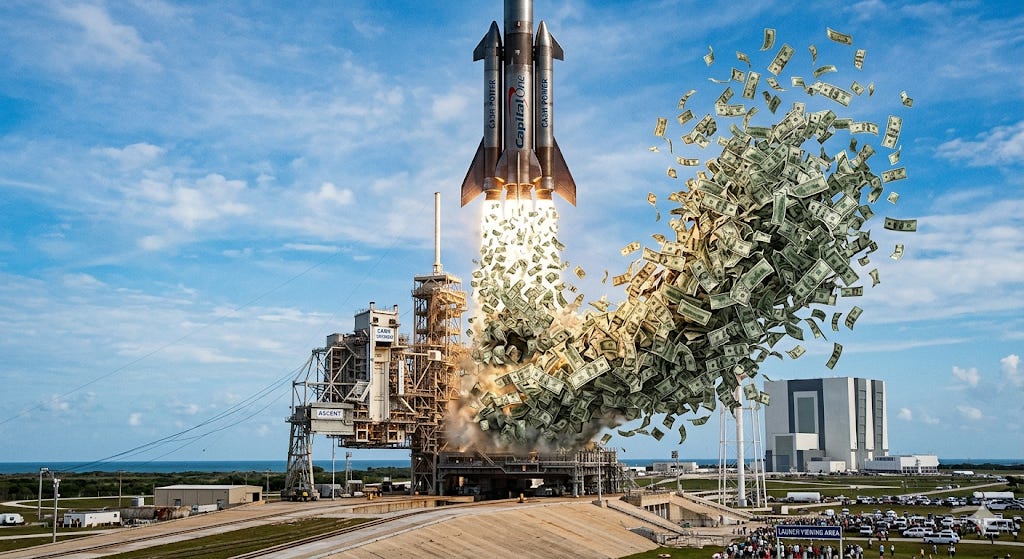
June of 2026 will likely be remembered in history as the month when SpaceX launched its IPO. With more fanfare than the launch of its rockets, the Elon Musk run private rocket company valued itself at 125 times 2025 revenue or $2 trillion. A modest internet search will return pages upon pages of articles about the IPO interspersed with information on how to buy. A valuation of 125 times 2025 revenue is certainly some interesting math, but the math problems don’t end there.
What will make June 2026 more interesting is its combination of history and math. Because it is a time in human history and humans are involved, this moment will be open to endless interpretation today and beyond. Because this moment involves an amount of money larger than the gross domestic product of 180 countries, we can look at some hard math.
No one on the planet, even those paid immense salaries to track this kind of thing, knows what the future holds for SpaceX nor for the commercial space industry it aims to dominate. There are some numbers that are informative in these wee hours of SpaceX’s life as a public company and, just like my mother said, math “either is or it isn’t.”
Valuation
Taking a company public is no small feat because doing so opens the company to statutorily mandated scrutiny of its business and books. The company in question must file an S-1 form with the Securities and Exchange Commission (SEC) as required by the Securities Act of 1933. The intent of this process is to give investors material financial information prior to investment to prevent fraud and ensure transparency. As a result, companies filing for an IPO must disclose their accounting, revenue, and a business plan for investors to evaluate.
SpaceX was required to do this opening a window into the company’s financials for the first time. Before getting to the valuation, another piece of math is important for investors: the total addressable market (TAM). TAM is a business term that refers to the size of the market for the product or service you are providing. If you make bicycles, the TAM would be the number of people in the world that either do ride bicycles or that you project will in the future. TAM speaks to the size of the growth opportunity. In a standard IPO, a company might say their TAM is $100 billion and they intend to capture, say, 20% of that market from their current position of 5%. That does not mean they will own all $100 billion but that they have substantial room to grow and provide investors with returns. This speaks directly to the valuation the company gets.
In its SEC filing, SpaceX claimed a TAM of $28 trillion…with a T.
That means that SpaceX sees a market that is equivalent to the entire GDP of the United States for its rocket business. This number is enormous, even by tech company standards, and is based on A LOT of conjecture.
SpaceX claims that its valuation will be over $2 trillion because it will be the primary carrier of people to the Moon and Mars and likely the builder of multiple data centers in space. The cost for all of this is indeed high and doing the math without the context may have gotten you to $28 trillion. But there are some very real realities between June 2026 and a $28 trillion TAM.
Implicit in a TAM number is that the people inside that market are willing to pay that amount for bicycles for example. That’s almost always based on historical sales numbers, trends, and other analysis that leads to an informed estimate of the size of the market. A TAM in the double-digit trillions assumes that there are earthlings, companies, individuals, and governments, that are willing to part with a combined sum of $28 trillion for space services. The problem here is that the math on which such a number is based lacks the historical backing of traditional IPOs. It sounds great in a marketing piece but lacks substance.
But wait, there’s more.
The ability to launch trillions of dollars’ worth of rockets, materials, satellites, and humans into space requires common use space infrastructure that does not exist. When we refer to the “space economy” we are really only referring to the low earth orbit (LEO) economy because that’s as far as commercial space companies have thus far been willing to go. Not because the technology does not exist, but because they are not willing to eat the risk and go it alone. Without building out real space infrastructure, all the Starships in the world aren’t going to take us to Mars because now SpaceX has a legal responsibility to make money for its shareholders. Being first to go to Mars is a HUGE business risk and without infrastructure, it’s likely moot. That hard fact is the first slice cut out of the $28 trillion TAM.
Data Centers in Space
This publication has previously written about data centers in space from the perspective of the cost to launch one. Here’s some more math:
The weight of server racks can vary but is roughly 2,000-3,000lbs per rack. We will average it to 2,500lbs. In a modern hyperscale data center there are roughly 2,500-5,000 server racks, let’s use 3,000. At $1,500 per kilogram to launch any material to LEO, the costs break down this way:
Single Server Rack: 2,500lbs (1,134kg) = $1.7 million
Total Hyperscale Data Center Servers: 3,000 server racks at 2,500lbs each = 7.5 million pounds (3,402 metric tons or 3,402,000,000 kilograms) = $5.1 trillion
SpaceX will say that the launch cost per kilogram will drop to $20 or even lower. Maybe. If it does, it will take years, further pushing out the returns for investors. While the cost to put a single data center in space is boggling high, that’s not the end of the story.
The Earth is 70% water (I’ve seen a lot of it).
The inhabitants of 70% of the Earth’s surface do not buy compute space or data storage because they are fish.
Extremely basic orbital mechanics tells us that anything orbiting the Earth in LEO moves around 17,000 miles per hour, so it does not stay overhead long.
For a data center to transmit your data and compute to you on demand, it needs to be overhead. The principle is the same for Starlink. That’s why there are so many of them.
If that data center is on the other side of the world at the time you need it, tough luck. If the data center happens to be over the Western Pacific, its downlink does no one any good.
In order to effectively build data centers in space, you’d have to build A LOT of them…at $5 trillion a piece. If you happen to be the majority shareholder of a rocket company, this sounds just fine. If you are a government or a company that might hire SpaceX to do such a thing, this is prohibitive. This cost goes even beyond what the top 10 GDPs in the world could reasonably pay taking ANOTHER chunk out of the $28 trillion TAM.
Data centers in space would require complex data relaying, a drastic lowering of launch cost per kilogram, and other technologies not yet invented. That’s not to say we will never invest the right technologies, but is data centers in space where we want to invest that capital and tech? If you are on SpaceX’s board, you are certainly hoping so. But now that SpaceX is public, other investors get a vote.
2025 Revenue
It is standard practice to use the previous year’s revenue to forecast future revenue. But a funny thing has happened with SpaceX’s revenue. It’s Starlink business is strong, but its merger with xAI is a curious albatross hanging around its neck. It’s launch business is another matter and has been previously written about by this publication.
In 2025, the US accounted for 160 launches, of which 145 were SpaceX. Of those 145, 107 were Starlink satellites leaving 38 SpaceX launches that were not launching at SpaceX payload. Two important observations emerge:
SpaceX accounted for 90% of US launches in 2025 and 93% of launches in 2024.
Of SpaceX’s 145 launches, 73% were Starlink leaving a very small non-SpaceX market for the launch of LEO satellites. It is possible that SpaceX is artificially inflating the market for LEO launch capabilities because it is launching so many of its own satellites rather than satellites from outside customers.
Just 27% of SpaceX’s launches were NOT its own gear. Starlink satellites will continue to need replacing, but the demand for launch services is inflated, another chunk of the $28 trillion TAM gone.
The Space Economy
SpaceX has made a habit out of being first and the space economy is better for it. It’s now done something else first, IPO. The decision to IPO was not a bad one and there is an argument to be made that this may kick other space companies into gear and push the space economy beyond LEO. That’s only going to be true of certain prerequisites are fulfilled and so far, they are not. Data centers in space are fantasy and space critical infrastructure is not as sexy as going to Mars. Starlink will continue to turn revenue, but xAI and the demand for non-Starlink launch services would suggest a real issue with some of the math.
As my mother said, math “is or it isn’t.” The math around the SpaceX IPO is not hard to decipher. Today, the math around this IPO surrounds Elon Musk’s status as the first trillionaire in history and the early surge of SpaceX stock prices. Not even the math can predict the future, but we can use it as an indicator that cut through very clear hype. If the space economy is going to seriously turn the profits it is predicted to, the SpaceX IPO will not do it alone. SpaceX needs to either invest in space critical infrastructure or encourage its build to enable its own assets to start turning profits. The math indicates that returns are a long way off and the TAM is significantly overinflated. History will judge June 2026’s place in the space economy’s development and there will be plenty to debate and interpret it.